DMSO et coeur
extrait de : https://www.midwesterndoctor.com/p/dmso-heals-blood-vessels-and-could?
The Heart
Because the heart, like the brain, is exquisitely sensitive to oxygen deprivation and to the flood of free radicals that accompanies the restoration of blood flow, DMSO’s protective and circulation-promoting effects have shown promise for many heart conditions (e.g., physiologic concentrations of DMSO enhanced respiratory control ratio and viability of heart cardiomyoblasts1).
For example, DMSO’s scavenging ability has been shown to protect the heart from many stressors. These includes protecting heart-muscle contractility from iron-induced oxidative injury,1 completely blocking radical-mediated damage to the calcium-handling machinery of cardiac cells,1 preserving the sodium-potassium pump during ischemia-reperfusion,1 protected the cultured chick embryo cardiac myocytes from injury caused by hydrogen peroxide,1 and preventing lipid peroxidation of heart-cell membranes under bacterial-toxin stress.1
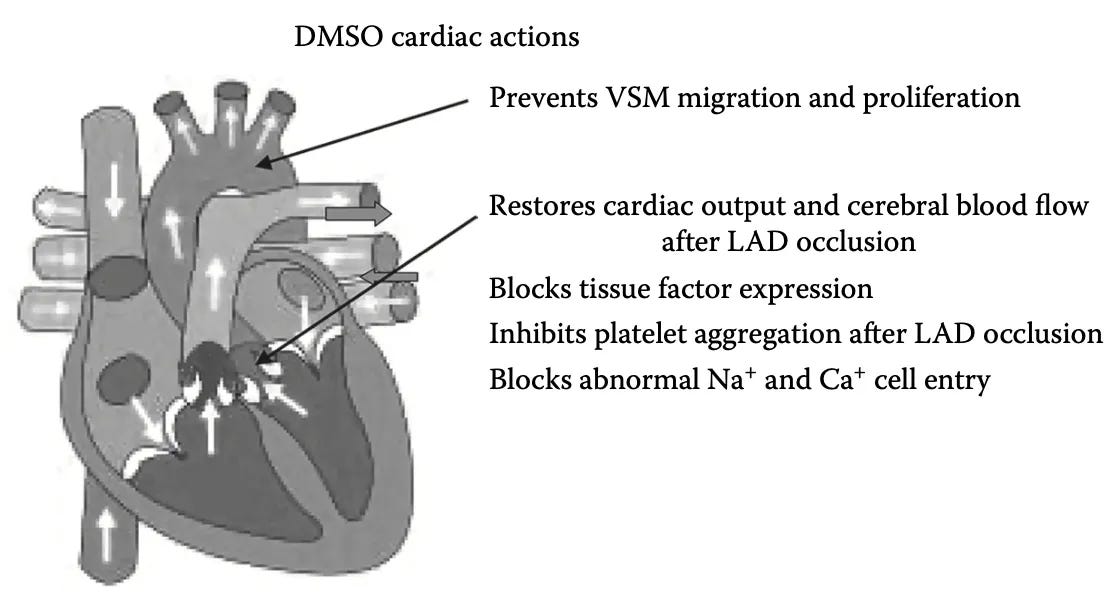
Ischemia and Heart Attacks
As DMSO’s therapeutic properties in strokes directly translate to heart attacks, many studies have explored it here:
•When the heart’s blood supply is impaired, its ability to pump is as well (which is part of why heart attacks are a downhill spiral, as the heart loses the ability to give itself the blood it needs). When heart attacks were modeled (e.g., by ligating the coronary artery to impair the heart’s blood supply), DMSO was able to counteract this. For example, in a dog heart attack study, an IV bolus of DMSO raised cardiac output to 1.65 L/min by the third hour versus 1.15 L/min in untreated controls, alongside lowering systemic vascular resistance and increasing cerebral blood flow.1 Likewise, in another dog study, intravenous DMSO (2 g/kg as a 50% solution*) transiently raised cardiac index from 4.56 to 6.91 L/min/m² and stroke index from 36 to 45 ml/beat/m² while dropping systemic vascular resistance.1
•In addition to preserving the heart’s vital function, many studies have shown DMSO prevents damage to the heart itself. In isolated rat hearts subjected to global ischemia-reperfusion, three days of intraperitoneal DMSO pretreatment (550 mg/kg*) cut infarct size from 50.0% to 21.2% and improved post-ischemic left-ventricular function.1 In rats where the coronary supply was cut for 30 minutes and then reperfused for 120 minutes, DMSO preserved coronary blood flow and reduced both the resulting necrosis (tissue death) by 57.6% and the ensuing left-ventricular dysfunction (an effect that was greater when DMSO was given for several days beforehand rather than immediately prior to occlusion).1 In another rat study, DMSO reduced the damaged portion of the heart by 76.18%,1 and in another it prevented contracture bands from forming in ischemic heart tissue (a common long-term complication of heart attacks).1
•Similarly, in pigs, DMSO significantly reduced intramyocardial hemorrhages and gross pathological changes,1 and in another study improved overall heart attack outcomes.1 In rabbits, giving hydrogen peroxide (H₂O₂) concurrently with DMSO immediately after occlusion reduced the damage still further, presumably by supplying oxygen to the starved tissue.1 Consistent with this, in models of heart attack DMSO reduced the oxidative markers and preserved the antioxidant enzymes that track myocardial injury.1,2
Furthermore, a large part of the damage in a heart attack comes not from the loss of blood flow itself but from its restoration, and DMSO addresses this reperfusion injury directly. In perfused rat hearts, 10% DMSO attenuated the oxygen paradox, reducing reoxygenation creatine-kinase release from 25.3 to 7.2 IU/g and cutting calcium-paradox enzyme release from 134.1 to 54.9 IU/g,1 and it likewise protected against the reperfusion injury caused by calcium-containing solutions.1 In isolated cardiac muscle it preserved contractility during hypoxia,1 an effect echoed in rabbit studies of preserved contractile strength1 and maintained cardiac output and brain perfusion in dogs.1
This same protection extends to hearts held for surgery or storage: in isolated rat hearts, 0.5% DMSO reduced post-storage contractile dysfunction during hypothermic ischemic storage,1 and when added to cardioplegic solutions (used to stop the heart during surgery) at 0.55%, fully preserved mitochondrial respiration after two hours of global ischemia.1 Combined with cardioplegia and alpha-tocopherol,⬖ DMSO likewise improved rat-heart function through ischemia.1,2 Beyond ischemia, it protected against endotoxin-induced myocardial injury,1 improved survival in endotoxemic rats,1and shielded the heart from intravenous potassium (given at the dose used in lethal injections).1 Most notably, with a cardiac enzyme that normally breaks down ATP (extracted from cow hearts) once mixed with DMSO, it instead synthesized ATP, suggesting DMSO can create a cellular environment that favors energy generation—particularly when the conditions cells normally rely on for it are absent (e.g., during a heart attack).1
Reviews have accordingly proposed DMSO as an antioxidant therapy for myocardial ischemia reperfusion injury1 and summarized its cardiac and CNS pharmacology,1 and reviews of renal and organ protection in aortic surgery note that low-dose IV DMSO restored cardiac output after coronary ligation in dogs while scavenging free radicals, blocking Na⁺/Ca²⁺ influx, and suppressing platelet aggregation.1
Note: as DMSO’s effects are dose and administration dependent, some studies found weaker results. For example, where DMSO served only as the solvent control, it sometimes protected on its own: in a rat deep-hypothermic-circulatory-arrest model testing ebselen, the DMSO solvent-control group itself showed partial protection on several markers, limiting attribution of the benefit to the drug.1 Likewise, in a canine model of coronary occlusion and reperfusion, intravenous DMSO reduced infarct size but not to a statistically significant degree (43.7% vs. 53.4% in controls),1 in two others the benefit was small1,2 and in another heart attack study I located, DMSO provided no benefit (which was likely due to 50% DMSO being directly infused).1 All of this indicates that while helpful, it is not guaranteed DMSO will be able to help every heart attack.
Lastly according to one of the main DMSO authors,1 DMSO was used to treat angina pectoris, heart attacks and prevent heart attacks by physicians in Chile (likely at the dose of 2g/kg). However, despite my best efforts, I could not locate the published paper he referred to with the limited information provided, so it’s likely impossible to corroborate this claim.
Cardioprotective Combinations
Many agents delivered in DMSO reduced infarct size, apoptosis, or oxidative injury in myocardial ischemia-reperfusion and cardiac-arrest models.
Polyphenols & flavonoids — curcumin⬖ (reduced inflammatory cytokines and oxidative stress) 1,2,3,4,5; resveratrol⬖ (reduced oxidative stress and inflammatory cytokines) 1,2,3,4; quercetin⬖ (shrank the infarct) 1; lycopene⬖ (reduced heart-cell death) 1; propolis⬖ (improved heart function) 1; dihydromyricetin⬖ (reduced inflammatory cytokines and cell death) 1; eriocitrin⬖ (improved cell survival and oxidative stress) 1; danshensu⬖ (reduced oxidative stress and cell death); Licochalcone A⬖; curcumin⬖; quercetin (with Ala-Gln)⬖; eriocitrin⬖; tanshinone IIA (PLGA nanoparticles)⬖(protected against oxidative damage); genistein⬖ (reduced oxidative stress); flavonols⬖(preserved the heart’s pumping strength); mangiferin⬖ (antioxidant protection against a chemically induced heart attack) 1.
Alkaloids & terpenes — carvacrol⬖ (reduced infarct size and cell death, and reduced mitochondrial fission)1,2,3; higenamine⬖ (reduced infarct size and improved heart function) 1; notopterol⬖ (improved heart function and reduced scarring)1.
Saponins, terpenoids & other botanicals — ginsenoside Rh2⬖ (reduced inflammatory cytokines) 1; ginsenoside 20(S)-Rh2⬖ (improved heart function)1; ginsenoside Rd⬖ (cut infarct size from 36% to 21%, and shifted immune cells toward healing)1,2; magnolol⬖(reduced infarct size)1; honokiol⬖ (reduced infarct size) 1; asiatic acid⬖ (reduced cell death and oxidative stress)1; curculigoside⬖ (improved cell survival and reduced infarct size)1,2; tanshinone IIA⬖ (reduced cell death and inflammation)1,2; astragaloside IV⬖(promoted new blood-vessel growth)1,2; triptolide⬖ (reduced inflammation and scarring)1.
Anesthetic (pre-/postconditioning) agents — propofol (reduced cell death)1,2; sufentanil1; sevoflurane (reduced infarct size 36% vs 56%)1,2; desflurane (reduced infarct size 48% to 19%) 1; isoflurane1.
Mitochondrial & metabolic-pathway agents — hydrogen sulfide donors (repeatedly reduced infarct size, including in diabetic hearts)1,2,3,4,5; rapamycin (protected diabetic and normal hearts, cutting infarct size from 36% to 13%)1,2,3,4; Mdivi-1 (reduced infarct size and cell death, including in diabetic and pre-diabetic hearts)1,2; MOTS-c (reduced infarct size)1; diazoxide (reduced oxidative stress and preserved mitochondria)1,2; carbon monoxide-releasing molecules (reduced injury)1,2,3.
Repurposed clinical drugs & metabolic agents — dapagliflozin (reduced inflammatory infiltration)1; canagliflozin (improved heart function)1; lovastatin1; simvastatin (reduced infarct size 39%)1; atorvastatin (reduced infarct size)1; roxadustat (reduced infarct size and cell death)1; ciglitazone (reduced infarct size and inflammation)1; tert-butylhydroquinone (tBHQ)⬖ (reduced oxidative stress); compound C⬖; γ-secretase inhibitor⬖ (reduced oxidative stress); nifedipine and diltiazem⬖ (reduced inflammation and oxidative stress); pioglitazone⬖; NS398 / Ca-channel blockers⬖; sorafenib (toxicity model)⬖; probucol⬖ (reduced ferroptosis, a form of iron-driven cell death); allopurinol⬖; DMOG (HIF-1α activator)⬖; pioglitazone (PA/high-glucose)⬖; agent (equal-volume ip DMSO vehicle)⬖; netrin-1⬖ (reduced oxidative stress and cell death); ferrostatin-1 (reduced ferroptosis)1; 3-iodothyronamine (reduced infarct size)1.
Hormones — 17β-estradiol (reduced microvascular damage)1,2,3.
Cell-death & protease/lipoxygenase inhibitors — ilomastat (reduced infarct size)1; MI-2 (restored the cell’s ferroptosis defenses)1; necrosulfonamide (improved recovery after cardiac arrest by blocking programmed cell death)1; ML355 (improved heart function in pigs and monkeys)1; zVAD-FMK (reduced injury) 1.
Receptor, kinase & other targeted agents — MMI-0100 (cut the loss of heart function by half and halved scarring)1; MHBFC (reduced infarct size and inflammatory cytokines)1; ginkgetin (reduced infarct size and inflammation)1; IB-MECA (reduced infarct size by about 40% in dogs)1; 9-phenanthrol (reduced infarct size from 38% to 9%)1; LGK-974 (improved heart function 62% vs 41%)1; ticagrelor (reduced inflammation)1; MG132 1; L41 (reduced infarct size and spurred heart-muscle regrowth)1; SEW2871 (shifted immune cells toward healing)1; left-ventricular unloading1; HU-210 (reduced infarct size).1
Reader Heart Attack Reports
While CPR can produce miracles, the reality is that it typically doesn’t (e.g., 10.5% of people with heart attacks resuscitated out of the hospital by EMS survive1 and 22-24% of those resuscitated in the hospital survive1). Because of this, I’ve put quite a bit of thought over the years into how this can be improved, and in parallel, we’ve collectively had quite a few cases where something we expected to work (e.g., a natural agent which improves circulation or eliminates clotting) did, including a few cases with DMSO. Given DMSO’s properties described above, I’ve hence repeatedly wondered if injecting DMSO during a cardiac code (CPR protocol) could have saved the person—but due to how unorthodox this was, this was understandably impossible to test. Likewise, while I know of cases where DMSO has been used to treat a heart attack, the reality of the situations around heart attack make giving it quite difficult, so I have much less experience with this than DMSO for strokes. As such, while I suspect it would be lifesaving, that is nothing more than a guess without adequate clinical experience to begin corroborating it and hence not something I can stand behind.
For that reason, I did not previously broach this, but nonetheless a few reader tried it anyways and reported success in stopping heart attacks,1,2,3,4,5,6,7 along with two who stated it healed complications of COVID vaccine induced heart attacks.1,2
Of these, the most interesting one that came from a woman who described her husband getting through what she characterized as a heart attack with a blockage and ischemia, using DMSO and aspirin at the onset and then frequent DMSO over the following days, and coming through it with no measurable heart damage and feeling nearly normal a week later.1 Notably, she independently described the same three-stage structure this section lays out: an initial circulatory phase, in which she believed the DMSO and aspirin opened the blockage in the first minutes; then the oxidative-stress phase of the first few days, in which frequent DMSO was aimed at preserving the heart tissue that reperfusion would otherwise damage; and finally the fibrosis phase from roughly days three to seven, each of which she noted, called for a different approach.1
Note: one reader also reported DMSO helping angina,1,2 and another concerning chest pain.1
Myocardial Necrosis and Fibrosis
DMSO also limits the death and scarring of heart muscle. In rats given isoproterenol (a standard chemical model of infarct-like injury), DMSO reduced fiber necrosis, prevented ventricular aneurysm formation and cardiac rupture, and left a smaller residual area of fibrosis,1 an effect confirmed in a second isoproterenol study,1 in further work showing reduced oxidative stress after isoprenaline,1 and in dedicated work on DMSO and experimental myocardial necrosis.1 Finally, DMSO reduced the several-fold rise in creatine kinase, LDH, and α-hydroxybutyrate dehydrogenase and reduced histologic damage after isoprenaline.1
In a D-galactose accelerated-aging model, subcutaneous 4% DMSO lowered TGF-β1, normalized cardiomyocyte diameter, and reduced fibrotic area to near-control levels, an anti-fibrotic effect the authors attributed to DMSO itself.1 In a series of studies on copper deficiency (which drives cardiac hypertrophy), chronically administered DMSO inhibited the hypertrophy, anemia, and heart-copper depletion via hydroxyl-radical scavenging, attenuated the rise in heart weight and water content, and preserved mitochondrial and myofibrillar ultrastructure.1,2,3 Consistent with a radical-mediated mechanism, DMSO also reversed the copper-induced impairment of force generation, calcium handling, and myosin-ATPase activity in cardiac muscle1,2
Note: DMSO also protected older rat hearts from the stress caused by prolonged immobility and from dietary copper deficiencies.1,2,3,4,5
Cardiac Fibrosis & Remodeling Combinations
In the fibrosis and remodeling literature, the same anti-fibrotic or anti-hypertrophic effects was seen with many agents delivered in DMSO.
•Natural agents — curcumin⬖ (raised antioxidant defenses and reduced heart-muscle damage); curcumin⬖ (protected against heart-muscle damage); genistein⬖ (reduced hypertrophy, oxidative stress, and inflammation); atractylenolide III⬖ (reduced post-heart-attack scarring); gCTRP9⬖ (protected injured heart cells); RGS6 with DPI⬖(reduced remodeling); CRIF1 with NAC⬖ (protected injured heart cells); Maresin 1⬖(protected heart cells); andrographolide⬖ (reduced hypertrophy and scarring); baicalein⬖ (reduced heart-muscle damage, scarring, and inflammation); β-carotene⬖(reduced inflammation and scarring); resveratrol⬖ (reduced fibroblast overgrowth); tanshinone IIA⬖ (reduced hypertrophy); asiaticoside⬖ (reduced hypertrophy); salvianolic acid B⬖ (improved heart function); anacardic acid⬖ (blocked hypertrophy); colchicine⬖ (reduced fibrosis); nimbolide⬖ (reduced fibrosis in diabetic hearts); Buyang Huanwu Decoction⬖ (reduced post-heart-attack cell death).
•Pharmaceutical & synthetic agents — valsartan (reversed chemotherapy-induced remodeling)1; a JNK inhibitor (reduced fibrosis)1; a LOXL2 inhibitor (reduced fibrosis and hypertrophy)1; an EZH2 inhibitor (reduced fibrotic proteins)1; a GCN5 inhibitor (reduced hypertrophy and fibrosis)1; salubrinal (improved function in heart failure)1; rapamycin (improved pressure-overload hypertrophy)1; a Pannexin1 inhibitor (reduced hypertrophy and fibroblast activation)1; an H2S donor (reduced remodeling and blood pressure)1; dasatinib (reduced fat buildup and fibrosis in diabetic hearts)1.
Cardiotoxicity, Sepsis, and the Diabetic Heart
In 42 severely ill patients with septic complications of post-resuscitation disease, intravenous DMSO was an effective therapy, including in cases where the sepsis arose from antibiotic-resistant bacteria.1
Additionally, DMSO has been used with a wide variety of agents to protect chemically injured, septic, and metabolically stressed hearts where it frequently reduced cardiac enzymes, oxidative stress, inflammation, and apoptosis:
•Chemotherapy cardiotoxicity — Cissus verticillata⬖; Irvingia gabonensis extracts⬖(reduced heart-injury markers); ursolic acid⬖1,2 (improved heart function and reduced cell death); silibinin⬖ (promoted protective autophagy); necrosulfonamide (restored antioxidant enzymes)1; necrostatin-1 (reduced heart-injury markers and inflammation)1; a PARP inhibitor (reversed apoptosis and remodeling)1; azilsartan (reduced oxidative stress and cell death)1,2; selenium⬖ (reduced inflammation and cell death); avenanthramide-C⬖ (reduced oxidative stress and inflammation); rutin⬖ (raised antioxidant defenses and reduced inflammation).
•Sepsis-induced cardiac injury — Trimetazidine⬖ (protected against sepsis heart injury); D3T⬖ (raised antioxidant defenses); a pancreatitis-ascitic-fluid injury model(DMSO solvent control); paeoniflorin⬖ (reduced vascular leakage and inflammation); astragaloside IV⬖ (reduced oxidative stress and inflammation); astaxanthin⬖ (reduced injury signaling); curcumin⬖ (reduced heart-injury markers); luteolin⬖ (enhanced protective autophagy); sulforaphane⬖ (reduced inflammation); xanthohumol⬖ (reduced inflammation and cell death); octreotide (reduced inflammation and raised antioxidant defenses)1; simvastatin (reduced heart-injury markers and inflammation)1.
•Diabetic cardiomyopathy — GLP-1 drugs⬖ (reduced oxidative stress in heart blood vessels); tadalafil (protected mitochondria)1; rapamycin (reduced oxidative stress)1,2; ferrostatin-1 (reversed ferroptosis, a form of iron-driven cell death)1; honokiol⬖(reduced high-glucose fibrosis); resveratrol⬖ (reduced inflammation); EGCG⬖ (restored cell-to-cell coupling).
Combinations for Additional Heart Conditions
In pulmonary hypertension and pulmonary embolism, where the right heart is strained by elevated pressures, DMSO delivered agents benefited right-ventricular function and pulmonary vascular remodeling:
•Myocarditis — A proteasome inhibitor (reduced inflammation and apoptosis);1 an α7-nicotinic agonist,1,2 (reduced inflammation and cell death); carbon monoxide-releasing molecules (reduced mortality and heart injury);1 a 3C protease inhibitor (antiviral protection);1 an androgen-receptor inhibitor (reduced inflammation and enhanced autophagy);1 a tyrphostin (reduced inflammation).1
•Arrhythmias — A calpain inhibitor (reduced atrial-fibrillation incidence); mexiletine(shortened repolarization in long-QT models); fisetin⬖ (reduced atrial inflammation and fibrosis after heart attack); valsartan or an ERK inhibitor (reduced atrial fibrosis and remodeling).
•Pulmonary Hypertension (which also damages the heart)—Curcumin⬖1,2 (reduced platelet activation and heart-injury markers); resveratrol⬖ (reduced inflammation and heart strain); isoliquiritigenin⬖ (reduced right-heart pressure and oxidative stress); icariin⬖ (reduced inflammation); a fission inhibitor with 17β-estradiol (reduced right-heart enlargement and shifted immune cells toward healing); a TRAF6 inhibitor(improved right-heart function); a Pannexin-1 inhibitor (improved pulmonary artery flow).
Direct Effects on Heart Function
Several of DMSO’s standalone cardiac actions cut across all of the above. DMSO is a direct vasomotor agent, producing endothelium-independent relaxation of coronary and pulmonary arteries1. As a hydroxyl-radical scavenger it also attenuated tempol-induced falls in blood pressure, heart rate, and sympathetic nerve activity1. As discussed earlier, DMSO also protects coronary endothelium-dependent relaxation against oxidative injury, inhibits platelet aggregation, and suppresses tissue-factor expression and arterial thrombus formation—vascular protections equally relevant to the heart. A DMSO–aspirin preparation was likewise reported to reduce erythrocyte aggregation, normalize fibrin formation, lower peripheral vascular resistance, and improve microcirculation1. In the vehicle-delivered atherosclerosis and vascular-injury literature the same effects recur, with cinnamaldehyde⬖1 cutting serum lipids and raising heart antioxidant enzymes in atherosclerotic rats, hesperetin⬖1 limiting diesel-exhaust cardiovascular oxidative damage, and kolaviron⬖1 attenuating angiotensin-II/LPS-driven vascular smooth-muscle proliferation.
On the muscle itself it exerts direct, concentration-dependent effects on contractility, rate, and electrophysiology1,2,3: at low doses positive inotropy1—a moderate increase at 3% becoming marked at 6%1—while potentiating the inotropic response to isoprenaline1; still higher concentrations reversibly depress contractility1 or produce a mild hyperpolarization that prolongs the action potential1. These effects are independent of beta-adrenergic receptors1 and typically do not alter cardiac rhythm1, though the rate response is dose-dependent: 1–3% DMSO slightly raised heart rate while 6–10% markedly slowed it, an effect reversed by atropine1 and thus mediated through cholinesterase inhibition.
Note: DMSO and colchicine were found to increase myocardial work output.1
DMSO increased cardiac output during hypoxia1 and, given IV to dogs, raised cardiac output, stroke volume, and central venous pressure1. DMSO further protects cardiac t-tubules from stress-induced sealing1. On the parasympathetic side it inhibits cardiac acetylcholinesterase, lowering the vagal threshold and potentiating acetylcholine’s slowing of the heart rate.1
As discussed earlier, DMSO’s radical scavenging protects cardiac calcium handling, the sodium-potassium pump, and heart-muscle contractility against iron- and peroxide-driven injury making antioxidant protection equally relevant here. Beyond those, in cell-free and isolated-heart systems DMSO acts as a direct radical scavenger on its own: it neutralized electrolytically generated oxygen radicals in an enzyme-free buffer1, protected rabbit hearts against radical-driven rises in coronary and end-diastolic pressure and albumin leakage1, raised coronary release of protective uric acid in guinea-pig hearts1, and served as the reactive-oxygen scavenger confirming the antioxidant basis of protection against ischemia-reperfusion injury1. It also limits stress-induced lipid peroxidation in the myocardium1 (most pronounced in aged hearts), and in H9c2 cardiomyocytes it upregulates heme oxygenase-1 via p38 MAPK and Nrf2 to protect against hydrogen-peroxide injury1.
Differentiation of Heart Cells
DMSO has long been used to turn cancer cells back into normal cells and to steer stem cells into the cell types the body needs — a way to replace and repair damaged tissue, including the nervous system. A large body of work shows the same thing for the heart: DMSO alone reliably drives stem cells to become cardiomyocytes.
When stem cells are exposed to DMSO alone they are most often reported to become heart tissue, which points to a real role for DMSO in cardiac stem-cell protocols.
A very large literature has since used DMSO as a cardiomyocyte-differentiation inducer across many starting cell types, with the same result recurring: exposure to DMSO (typically 0.5 to 1 percent) drove the cells to switch on cardiac genes and structural muscle proteins and, in most reports, to form spontaneously beating cardiomyocytes.
By far the most studied model is the P19 (and P19CL6) embryonal carcinoma line, in which DMSO alone reliably produced beating cardiomyocytes and became the standard system for dissecting how it works.t1,2,3,4,5,6,7,8,9,10, 11,12,13,14,15,16,17,18,19,20, 21,22,23,24,25,26,27,28,29,30, 31,32,33,34,35,36,37,38,39,40, 41,42,43,44,45,46,47,48,49,50, 51,52,53,54,55,56,57,58,59,60, 61,62,63,64,65,66,67,68,69,70, 71,72,73,74,75,76,77,78,79,80, 81.
The effect shows up across source cell type after source cell type. DMSO alone has turned bone-marrow mesenchymal stem cells,2 into myocardial cells, adipose-derived stem cells into cardiomyoblast-like cells, and fetal liver stem cells into cardiomyocyte-like cells. It has also driven fetal cardiomyocytes to proliferate and boosted the direct reprogramming of fibroblasts into cardiomyocytes roughly five-fold.
The same DMSO-driven differentiation has been reported across species and stem-cell source: in goat embryonic stem cells, mouse embryonic stem cells1,2,3,4,5, human embryonic stem cells1,2,3,4,5, human bone-marrow stem cells, cardiac progenitor cells, and mouse embryonic fibroblasts.
Lastly, the same differentiation was also achieved when DMSO was combined with many other agents including 5-azacytidine, a cocktail of growth factors including BMP and FGF, retinoic acid with 5-azacytidine, oxytocin (which worked synergistically with DMSO) and many others.1,2
Note: the effect is again concentration-dependent. At high concentration the picture reverses: a brief exposure to 10 percent DMSO disrupted muscle fibers and suppressed proliferation in cultured heart and cardiac endothelial cells,1,2
Atherosclerosis
DMSO endothelial protective effects also allow it to prevent atherosclerosis itself. In rabbits fed a cholesterol-overloaded diet, oral DMSO reduced the resulting atherosclerosis by 30—40% and halved the cholesterol accumulating in the tissue.1Beyond limiting the damage, it also supported the vasculature’s ability to rebuild itself, as DMSO promoted the differentiation of human embryonic stem cells into endothelial, cardiac, and blood-cell precursors—the early cells the body draws upon to build new vessels and blood.1
Finally, a series of studies in the cells lining human umbilical veins (a standard laboratory stand-in for the vessel wall) point to a protective and anti-inflammatory action there. Pretreatment with 2.5% DMSO reduced the neutrophil adhesion TNF-α normally triggers, which is one of the first steps of vascular inflammation and the initiating event in atherosclerosis.1 In nutrient-starved cells it blocked programmed cell death by promoting DNA replication and enhancing survival,1 and under oxidative stress it raised heme oxygenase-1 and reduced apoptosis through several anti-inflammatory and cytoprotective pathways.1
Blood Pressure
As DMSO is a mild vasodilator which simultaneously increases parasympathetic tone and scavenges the radicals that stiffen and constrict vessels, there is a mechanistic basis for it reducing blood pressure. However, the direct evidence is quite limited and most of what exists is indirect.
For example, DMSO is used as a transdermal penetration enhancer for conventional antihypertensives such as diltiazem and labetalol, where it improves both how much of the drug crosses the skin and how far the pressure falls in hypertensive animals.1,2More importantly, it protects the vessels hypertension damages rather than merely the number on the cuff, as in rats made hypertensive with angiotensin II, DMSO reduced vascular hyperpermeability, smooth-muscle necrosis, and fibrin deposition in the small arteries by scavenging free radicals1—guarding the vessel wall even in cases where it did not move the pressure at all.
Note: as I’ve shown throughout the series, the primary value of DMSO for cardiovascular disease is its ability to protect the tissue rather than meet a numerical blood pressure threshold (which is often not even healthy).
DMSO is not, however, a blood pressure drug in the way an ACE inhibitor is, and as with every other system, its effect is concentration dependent. At the low solvent-level doses used in most research it is close to neutral, as DMSO-alone control groups repeatedly show no meaningful change in mean arterial pressure.1,2 Any lowering emerges only at the higher therapeutic concentrations where the vasodilation becomes pronounced, and at the far end of the range the direction reverses entirely—the same counter-current already seen when DMSO scavenged enough nitric oxide to nudge blood pressure up in horses. The clearest illustration of this is what happens when stem cell grafts cryopreserved in concentrated (10%) DMSO are infused rapidly, which produces a transient rise in blood pressure proportional to the DMSO dose1—the same high-concentration ceiling described in the safety section above. In short, DMSO is a mild and dose-dependent vasodilator whose most consistent contribution in hypertension is protecting the blood vessels rather than driving down the number on the cuff.
Readers, in turn, have described exactly what the mechanism predicts, and frequently stumbled upon it by accident. One woman had been applying DMSO to her husband’s belly at night for a pulled muscle when a checkup found his blood pressure had normalized; months of magnesium and potassium had only brought him to 150/90, but he now read 125/80.1
The pattern which recurs the most however is a rapid drop following a single oral dose. A 73-year-old found half a teaspoon in water took him from a usual 148/90 to 109/70 within thirty minutes, which he described as “way better than the meds I used to take.”1 Another, who had been pushed up to 40 mg of lisinopril and was applying DMSO over his carotids, watched a pre-DMSO 159/95 fall to 106/75 on the first reading afterwards.1 Others reported oral DMSO doing “more for my general inflammation and BP than aspirin or these days BP meds,”1 blood pressure finally dropping after years of unsuccessful diet, exercise, and weight changes,1 and a more modest shift from 160/90 to 150/80 which arrived alongside easier urination and sharper vision.1
Consistent with this being vasodilation rather than something else, a few readers instead noticed it as mild low-pressure symptoms when they used DMSO aggressively, one describing feeling “rather unsteady” with unusually flat and invisible hand veins during heavy use1 (which the German DMSO community believes accounts for why some people get temporary headaches from significant DMSO use). In others it was simply folded into a much broader recovery, such as the reader treating a vaccine injury with oral DMSO who listed normalized blood pressure among a long list of improvements,1 and another who found his blood pressure and cholesterol returned to normal once DMSO allowed him to discontinue Humira.1
Given all of this, I would expect DMSO to help certain kinds of blood pressure but not others (as many different things can cause the elevation). That said, blood pressure is not always a thing you want to treat (sometimes it being elevated is helpful)—although in the cases where it’s helpful to be elevated (to maintain perfusion through aging arteries), DMSO would likely at least somewhat bridge the gap due to its ability to promote circulation.
Note: because a few of these drops were both large and rapid, anyone already on blood pressure medication should monitor their pressure when starting DMSO rather than assume the two simply stack, as the reader above who was on 40 mg of lisinopril illustrates how quickly the combination can move things.


Commentaires
Enregistrer un commentaire