DMSO et troubles circulatoires périphériques
extrait de : https://www.midwesterndoctor.com/p/dmso-heals-blood-vessels-and-could?
Peripheral Circulatory Disorders
In addition to protecting tissues from death, DMSO is remarkably effective at removing excess fluid from outside the bloodstream, increasing circulation, and clearing circulatory obstructions such as clots, along with many other conditions which result from impaired circulation (and microcirculation).
Note: numerous observations of the years have led me to believe blood congestion is a primary cause of many ailments including varicose veins and hemorrhoids.
The pioneering DMSO researchers documented this early. Stanley Jacob found1 that half of Raynaud’s patients had their symptoms eliminated and that thrombophlebitis responded excellently, while two investigators using plethysmography demonstrated objective improvement1 in peripheral-artery insufficiency in a large number of patients given topical DMSO. DMSO was also shown to relieve diabetic circulatory problems including peripheral neuropathy1 and diabetic ulcers, where one study1 of hundreds of patients reported over a 94% success rate — and to help prevent future amputations (data which has since been extensively corroborated).
The early clinical series were substantial. A study of 67 patients with varicose ulcers1(39 women, 28 men) found a remarkable response even in chronic ulcers that had been present for years and had failed other treatments. Likewise a larger early1 study found:

DMSO’s vasodilatory action has long been invoked for frostbite, diabetic ulcers, and varicose ulcers1, and over a hundred studies have since corroborated these results.
Venous disease and varicose veins. The most consistent modern use is topical, much of it centered on Dolobene — a gel of DMSO, heparin, and dexpanthenol in which DMSO both carries the heparin through the skin and adds its own analgesic and anti-inflammatory action. Dolobene has been evaluated across the venous disorders1, used specifically for varicose vein disease1, and ranked by vascular surgeons and pharmacists among the priority topical agents for varicose veins1.2,3,4,5 An early double-blind study of 55 patients1 tested topical DMSO for chronic venous insufficiency, and a 1975 New York Academy of Sciences report1 documented its use across venous stasis, dermatosclerosis, and lymphedema. It recurs throughout the topical treatment of chronic venous insufficiency and post-thrombophlebitic disease1and appears in the formulation literature for antivaricose gels1 and horse-chestnut/aescin preparations1 as the penetration enhancer of choice.1 This indicates DMSO may also play a wall-strengthening role (e.g., in a mouse model of venous hypertension1 that reproduces varicose remodeling, agents delivered transdermally in DMSO prevented the pathological changes in vein structure and smooth muscle that drive the disease).
Thrombophlebitis, superficial venous thrombosis and hematomas. DMSO-based gels are commonly used here. A randomized, double-blind trial of a Phlebolan spray1 and related studies1,2,3 support topical DMSO-heparin (and the topical DMSO heparin gel Dolobene) for superficial thrombophlebitis.1 Likewise Dolobene recurs as a standard thrombophlebitis and thrombosis therapy throughout the literature, including for combined deep and saphenous-vein thrombosis.1,2,3 DMSO (alone) gels have also been used to treat acute thrombophlebitis1, superficial-vein thrombosis1, and chemotherapy-induced phlebitis.1,2,3 Electrophoretic DMSO has also resolved intramuscular-injection hematomas in hemophilic children, clearing the bruising well enough to let their therapy continue.1
Venous, trophic, and diabetic ulcers. DMSO’s ulcer record (e.g., the greater than 94% success rate and the 67-patient varicose-ulcer series above) are highlighted in many papers discussing the use of large DMSO containing wound-dressing for venous trophic ulcers and lipodermatosclerosis1, chronic trophic leg ulcers1, post-thrombophlebitic trophic ulcers1, venous ulcers and chronic venous insufficiency (in one study a DMSO powder healed 95% of patients at 3 months versus 70% on placebo),1,2 and trophic ulcers of atherosclerotic origin (with a DMSO powder)1. In 58 patients with chronic purulent wounds from vascular disease or diabetic angiopathy, negative-pressure instillation of 20% DMSO produced faster cleansing, near-complete granulation in 76% by the first dressing change, and healing 1.5–3× faster than standard care.1,2 The diabetic-foot thread is distinct: in 80 diabetic patients with lower-extremity ulcers, DMSO dressings combined with an oxygen-carrying perfluorocarbon cut mean healing time to 17 days versus 47 for standard care, with faster bacterial clearance and a better microcirculatory index by day 22.1 DMSO is also used as an antiseptic and penetration enhancer in diabetic-foot and gangrenous-wound protocols1, in diabetic wound management with documented perfusion improvement1, for necrobiosis lipoidica and other diabetic skin conditions1, and as the vehicle in experimental diabetic-wound and angiogenesis models.1
Scleroderma and Raynaud’s. In addition to the 50% Raynaud’s symptom-elimination figure from the original DMSO literature, DMSO is a standard component of scleroderma care specifically for its microcirculatory action. DMSO with nicotinic acid⬖ has been used to treat systemic scleroderma,1 and topical DMSO (often paired with heparin) is mentioned as a treatment throughout the scleroderma treatment literature1, including pediatric localized scleroderma1, explicitly to improve microcirculation and soften dermatosclerosis.1,2,3,4,5,6,7,8 (where in one study, blood flow was increased 20% by DMSO and 500% by DMSO with nicotinic acid⬖1). It also appears in systemic lupus with acrocyanosis and Raynaud-type lesions1, in vasculitis1with cutaneous circulatory involvement, and as the vehicle for vasoactive agents in scleroderma1.2
Note: many more scleroderma studies are discussed here.
Tissue perfusion, flap and graft survival. The most objective experimental evidence that DMSO raises tissue blood flow comes from surgical flap models, where perfusion decides whether ischemic tissue lives. In 48 rats with abdominal island flaps1, systemic DMSO significantly increased perfusion (by laser Doppler and perfusion fluorometry) and improved flap survival. In ischemic dorsal skin flaps1, 5% DMSO reduced distal necrosis and produced greater neovascularization and earlier repair. The benefit recurs across independent models such as pedicle-flap necrosis1,2,3,4 composite and vascular allografts1, or nipple-areolar and penile tissue salvage1.2 The same perfusion gain runs through a large wound-healing literature, where DMSO (alone or as carrier) increases skin blood flow1, normalizes capillary permeability and microcirculation1, improves isolated-organ perfusion1, and accelerates granulation and revascularization in trophic ulcers, burns, and other wounds.1,2,3
Note: many additional DMSO skin flap studies can be read here.
Surgery. In addition to protecting skin flaps (a common challenge in plastic surgery), DMSO also addresses many other challenges. In breast reconstruction, applying topical 60% DMSO before each tissue-expansion session cut expansion time by roughly a third, allowed greater volume per session, and reduced pain1, across two clinical series.1 Topical DMSO salvaged (saved) an ischemic nipple-areola complex1after reduction mammoplasty by restoring perfusion, and as a trauma wound dressing used in nearly ten thousand cases it dilated capillaries and improved microcirculation1. Finally, in 154 patients undergoing surgery to restore blood flow to an acutely ischemic leg, intravenous DMSO added before reperfusion reduced markers of reperfusion injury1 ( lower peak lactate, faster normalization, fewer cases of kidney and cardiopulmonary dysfunction) though amputation and mortality were unchanged.
Hemorrhoids and frostbite. DMSO is used in topical mixtures for acute thrombosed hemorrhoids1 and hemorrhoidal thrombosis1, in a placebo-controlled trial of an MSM⬖-containing gel1 (MSM being DMSO’s oxidized metabolite), and in anorectal wound healing after hemorrhoid surgery1.2,3 For frostbite, a peripheral cold-ischemic injury, DMSO appears in the treatment guidelines for local cold trauma1, in military cold-injury research1, and as a carrier delivering heparin into cold-injured tissue1.2,3,4,5
Note: Stanley Jacob (the pioneer of DMSO) treated hemorrhoids with DMSO,1 other DMSO authors have advocated for using DMSO to treat them, and Merck (in their early clinical trials) reported that it improved recovery after their surgical removal.1
Arterial and ischemic limb disease. The arterial side is thinner than the venous but present: DMSO has been used adjunctively for arterial disease of the extremities1, for chronic purulent wounds from advanced peripheral arterial occlusive disease1, with hyaluronidase for ischemic limb edema1, and for vaso-occlusive hand-foot crises1where Dolobene relieved pain and edema. It also improved facial arterial blood flow after surgery1.
Veterinary peripheral circulation. In veterinary medicine, where DMSO is a mainstream drug, it is used for equine laminitis to improve digital perfusion1, distal-limb edema1, and aorto-iliac thrombosis1, in regional limb perfusion1 and tendinitis1, for bovine hoof and teat lesions1, and as anti-endotoxemic support in colic and peritonitis1 where circulatory collapse is the threat.1,2
DMSO also completely abolished toxin-induced constriction of lymphatic microvessels1, protecting lymphatic as well as blood-vessel tone.
Peripheral-Vascular Combinations
Many agents have also been combined with DMSO to topically treat the same conditions DMSO alone also treats.
Venous Disease, Trophic Ulcers & Wound Healing
Many agents combined with DMSO, like DMSO alone, speed cleansing, granulation, and closure of venous, trophic, diabetic, and traumatic wounds:
•Antiseptics & antibiotics (topical wound care) — furacillin + sensitivity-selected antibiotics (25% DMSO cleared monoflora by day 5–6 and healed varicose/post-thrombophlebitic ulcers in 16 days, 2.2x faster with phototherapy)1; chlorhexidine (multimodal venous trophic-ulcer regimen; remission in 80–95% of 152 cases)1; bactosin + sulbactam (DMSO antiseptic irrigation of contaminated vascular-trauma wounds; fewer thromboses, infections, amputations),1 photoditazine plus photodynamic therapy (gunshot wound treatment aiding cleansing and microcirculation)1,2.
•Anesthetics & anti-inflammatories (compounded dressings/ointments) — Anikol, a patented anilocaine ointment (~190-min surface anesthesia; infected wounds closed in 7 days, frostbite healed in 8)1; splenic preparation splenodimexide (anorectal wounds; complications cut >1.5x, faster granulation)1
•Free-radical scavengers & flavonoids (ulcer healing) — Quercetin⬖ (10% DMSO vehicle showed no independent effect while quercetin-in-DMSO drove angiogenesis and closure in diabetic wounds)1; loureirin A⬖ (promoted vascularization and wound healing via miR-339-5p/Wnt).1
Thrombosis, Clotting, Platelet Function & Vascular Tone
DMSO is frequently combined with other anti-clotting agents:
•Natural compounds — curcumin⬖ (dose-dependently reduced platelet aggregation, CD63, GMP-140 in pulmonary embolism)1; berberine⬖ (prolonged mesenteric-artery occlusion time; reduced venous thrombosis and NET formation in colitis)1; senkyunolide I (reduced platelet activation and NET formation in sepsis).1
•Anticoagulants & other pharmaceuticals — rivaroxaban (suppressed leukocyte adhesion and microthrombus formation in diabetic microvasculature)1; aspirin (DMSO + aspirin stopped nocturnal leg cramps within a day)1. Nadroparin (15% DMSO carried this LMWH into tissue to prevent Nicolau syndrome skin necrosis after sclerotherapy)1; hydrocortisone (90% DMSO potentiated hydrocortisone ~10-fold and, alone, prolonged arteriolar flow-stop time and sped flow restoration after venous thrombosis)1; Procaine + heparin (corrected vascular tone and arterial-bed filling in chronic interstitial parotitis).1
•Signaling-pathway inhibitors (thrombosis mechanism) — PI3K inhibitor wortmannin (malnutrition-driven venous thrombosis)1; suberoylanilide hydroxamic acid(improved survival and clot quality in sepsis coagulopathy)1; Tubastatin A (HDAC6) (reduced renal microcirculatory thrombin and NET formation in sepsis).1
•Polyphenols & natural vasorelaxants — resveratrol⬖ (near-complete relaxation of human intrapulmonary arteries, partly NO-dependent)1; garlic diallyl trisulfide⬖(endothelium-independent relaxation of intrarenal arteries, Emax >91%)1; tetrahydroxystilbene glucoside⬖ (mesenteric relaxation via COX-2/TXA2 and K+/Ca2+ channels)1; cannabidiol (potent inhibition of small-resistance-artery contraction, stronger in smaller vessels)1; resveratrol ⬖ + CAPE⬖ silibinin⬖ (concentration-dependent relaxation of human umbilical artery).1
Endothelial Protection & Microvascular Barrier
Polyphenols & flavonoids — resveratrol⬖ (raised hypoxic endothelial viability and SIRT1/PGC-1α; lowered inflammatory IL-6, ICAM-1, ROS)1; resveratrol⬖ plus atorvastatin (synergistically enhanced bone marrow stem cell endothelial differentiation and stent re-endothelialization beyond either alone)1; kaempferol⬖(protected islet microvessel endothelium from fatty-acid injury)1; astragaloside IV⬖(improved aortic-endothelial viability, migration, tube formation under hypoxia).1
Endothelial-barrier disruption — ulinastatin (blocked endothelial hyperpermeability via p38)1; HSPA12B pathway inhibitors (preserved endothelial barrier function),1thymoquinone⬖ (sepsis) (improved mesenteric-artery blood flow and aortic function,)1. resveratrol⬖ (cut sepsis leukocyte/platelet adhesion, improved survival),1 genipin⬖(reduced LPS-induced vascular hyperpermeability via SIRT1).1
Neointimal Vascular Remodeling after Artery Injury — celastrol⬖ (restored contractile VSMC markers)1; ursolic acid⬖ (also reduced NF-κB/PCNA)1; YM2016361; a Pol I inhibitor;1 enalaprilat (DMSO alone demonstrated a modest reduction in remodeling).1
Reader Reports
Since DMSO is easy to utilize for peripheral circulatory conditions, many readers have attempted it, and their testimonials mirror the successes for these conditions seen in the trials.
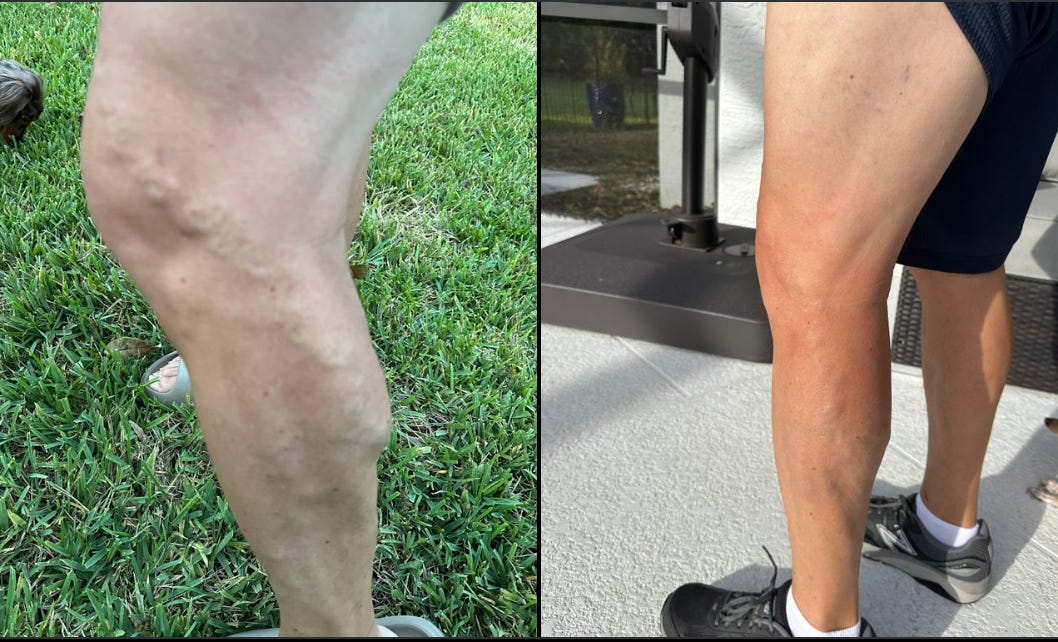
Varicose and spider veins. This is the single most common circulatory use readers describe, and the reports are strikingly consistent: repeated topical application (typically 70-100% DMSO,* often in aloe⬖ or castor oil,⬖ once or twice daily) shrinks, softens, fades, and in many cases eliminates the veins, frequently after they had been present for decades. One reader sprayed 100%* DMSO on varicose veins nightly and reported that “in 13 months they are entirely gone,”1 another in New Zealand treated badly “varicosed” saphenous veins roughly half a dozen times over a week and found the change (documented in before-and-after photos) durable: “I am fairly sure that the applications are not maintaining the varicose vein recovery-they are fixed.”1 A third watched veins that “stuck out about 1/2 inch” recede to “about 1/8 of an inch,”1 and one posted a 24-hour before-and-after showing a large varicosity essentially gone.1 Many more described veins that “just disappeared” along with the aching and end-of-day leg pain,1 that faded or shrank steadily with continued use1,2,3,4,5,6,7 that became “much smaller, softer” with the previous sensation of “thickness” gone1 or that improved only on the treated leg while the untreated leg served as an inadvertent control.1 A woman treating her elderly relative’s chronic venous insufficiency tracked it week by week—roughly 20% improvement in the first week, 50% by the second, 75% by the third.1Several noted the veins returned when treatment stopped1 and a minority saw little or no effect,1,2 but the dominant pattern was steady improvement of veins that conventional medicine treats only by stripping or ablation.1,2,3,4,5,6
These are some of the many pictures I’ve received:

Blood clots and DVT. Readers reported both topical and oral DMSO dissolving existing clots and preventing new ones, often as a deliberate replacement for prescribed anticoagulants. One who had been told to take Eliquis for life stopped it and switched entirely to oral DMSO to dissolve clots in the legs and lungs: “I’d be dead if DMSO didn’t work.”1 Another treated a bad DVT running from above the knee to the ankle with topical DMSO (plus lumbrokinase⬖ and serrapeptase⬖) and “dissolved the clot in 2.5 months,” declining the year of Eliquis doctors advised.1 A mother whose son had hip-bone necrosis from a clot lodged in a small twisted vein reported that after starting DMSO “within 3 days he was able to walk without pain,” and that the hip healed without the scheduled surgery.1 One reader whose arm had visible hardened clots from an IV reaction for months found “the clots were gone within three days” of applying DMSO gel,1 and another watched a large hard lump on a calf vein resolve until “it is gone now and the area soft.”1 Another described using DMSO to resolve a clot in an 89-year-old’s leg.1
Raynaud’s and cold extremities. For Raynaud’s, the reported effect is often nearly immediate. One reader who came in from shoveling snow put DMSO on the fingertips and was “instantly warm”;1 another applied it to the toes and it “changed the color of my toes back to normal.”1 A regular user reported applying it two or three times daily to her hands with “great success, no longer needing to wear fingerless gloves around the house...It has been life changing,”1 while another with cold hands happened to track the effect on a pulse oximeter and watched readings climb after each application.1 Others described relief of the spasms, discoloration, and stiffness,1,2,3marked overall improvement in circulation alongside the Raynaud’s,1 and one reported that five consecutive days of DMSO “cured Chilblains and Raynaud’s for the entire winter season.”1 Several with autoimmune-associated Raynaud’s (lupus, scleroderma, rheumatoid disease) folded it into broader regimens with reported relief.1,2,3
Ischemic and discolored limbs. Many reported normal color and warmth to feet and legs that had gone blue, purple, or black from poor perfusion. A daughter treating her 85-year-old mother’s severe foot neuropathy (toes and ankles “a blackish blue color,” numb, with nightly cramping) described the results after three weeks as “amazing” “the normal color has returned to her feet and legs...she now has feeling back in both of her heels.”1 Another reader rubbing DMSO cream on the feet nightly found that “on the fourth morning I looked down at my feet and all the purple mottling was completely gone.”1 One person watched an elderly mother’s “blue-black toes...from frostbite” return “to a healthy pink—permanently” after a single application of DMSO with magnesium.1 An 84-year-old with a decades-old radiation wound near the bone that had never fully healed reported that once she applied DMSO gel, “the skin color has returned to normal and circulation is now almost normal, my foot does not swell from lack of circulation.”1 Many others described impaired circulation, cold feet, leg swelling, and perfusion-related pain improving with topical or oral use1,2,3,4,5,6including a post-COVID reader whose cyanotic, “bluish purple” legs looked “a normal healthy colour...for the first time in 3 years.”1
Frostbite and cold injury. Frostbite is a peripheral cold-ischemic injury, and readers reported DMSO restoring warmth and color to affected tissue, often within hours, particularly when applied promptly. One who “burned” a hand with liquid refrigerant until “half of my hand went numb and changed color” applied DMSO and reported the hand “back to normal” two days later, with only a little surface skin peeling.1 A second described the same refrigerant injury (a hand “numb for 24 hours and changing color”) returning to normal in three days, adding that “immediate or even preemptive application is essential.”1 Another reported that on a “almost frost bite,” DMSO “restored warm asap.”1 These mirror the documented reports of frostbitten and blue-black toes regaining healthy color after DMSO.
Venous, diabetic, and pressure ulcers. DMSO’s reported effect on chronic wounds and ulcers is among the most consistent in this collection. A reader watched an elderly friend’s leg “a six inch diameter festering mess” that a year of medical treatment had failed to close, with surgeons wanting to cut “turn into clean skin” over a month of DMSO.1 A 12-year user reported that DMSO “saved a 75-year-old woman’s leg” doctors wanted to amputate: “she walks now despite being bedridden before.”1 Wives caring for diabetic husbands with chronic venous ulcers—one after a year of wound-care visits and twice-weekly home nursing—described the ulcers improving significantly within two weeks of switching to DMSO gel1 and not recurring afterward.1 A diabetic reader healed three foot ulcers with DMSO gel and pursued IV infusions to improve leg blood flow,1 and a man given DMSO cream by an acquaintance saw “a 2 inch ulcer” on his arm heal over “in a couple of weeks.”1 The same pattern appears with pressure sores: a family applied 80% DMSO to a bedbound 101-year-old’s bedsores and reported her skin “became normal in just a matter of days,”1 and a caregiver treating early Alzheimer’s incidentally cleared his wife’s “horrid bed sores,” leaving her “with no sores or irritated pink skin.”1 Others reported healing of diabetic leg ulcers, lupus-related skin ulcers, and assorted chronic sores, often in combination with iodine, silver, or chlorine dioxide.1,2,3,4,5,6
Hemorrhoids. Because a hemorrhoid is essentially a swollen, clotted vein, readers repeatedly found it responded to DMSO the way varicosities did—often within days (to the great surprise of skeptical readers).1 One applied “two drops of DMSO on a hemorrhoid I had for years” and reported that “after a single dose, it shrank to the size of a grain of sand.”1 Another reported that two friends “had their hemorrhoids vanish after a single subcutaneous thigh injection of .5ml of DMSO,” including one who had had them for 15 years.1 A reader whose doctor had diagnosed a hemorrhoid and written a prescription instead applied DMSO to the bulge and reported it “gone” after three days,1 and another who makes DMSO-cocoa butter suppositories reported they “heal and relieve hemorrhoids immediately...Prep H is useless.”1 Many more described hemorrhoids shrinking, clot release accelerating, and pain and itching resolving with topical gels, suppositories, or oral use, frequently after over-the-counter suppositories had failed.1,2,3,4,5,6,7,8,9,10,11
Lastly, readers describe a number of adjacent circulatory and lymphatic uses that don’t fit neatly under a single heading. DMSO was credited with improving lymphedema and restoring sensation in a diabetic reader’s legs and feet (from roughly 20% to 85% feeling),1 softening the “cord” of post-surgical axillary web syndrome until it “feels like a thin cotton string,”1 and relieving lymphatic congestion in the neck and shoulders.1Two readers with pigmented purpuric dermatosis (capillaritis) reported the discoloration fading—one by “at least 50%” after months of oral DMSO following chemotherapy-induced capillaritis on both shins,1 another finding that DMSO “drains blood from purpura in my older skin within 3-4 days.”1 A reader with peripheral arterial disease found DMSO cream slightly eased claudication pain enough to resume treadmill walking,1 and a post-COVID reader reported it changing “the micro clotting and total arterial blockage” of a popliteal artery.1
Ending Fifty Years of Neglect
When I began this series nearly two years ago, I stated at the start the evidence showed DMSO could save millions from neurological disability or death. Now that I have been able to present that evidence, it should be clear there is something real here, and a lot of the suffering that happens doesn’t need to. I cannot begin to describe how much I wish DMSO could become the standard of care for strokes, and it is for that reason that I have tried so hard with pieces like this to effectively make the case for that to happen.
At the same time however, another one of DMSO’s unique characteristics is that even if the medical system wants to maintain its narrow paradigm of how medicine must be practiced, DMSO can still be used by anyone who has taught themselves how to do so. This is critical, both because it means an option exists now that can be taken to avoid these devastating outcomes, but also because the one type of pressure medicine does respond to is external economic ones (e.g., individuals shifting enough of their medical spending to a superior alternative that medicine is motivated to provide a service that is good enough to recapture those customers). So, since DMSO can address so many both common and rare “incurable” ailments, it not only provides an immediate and tangible benefit to those who use it, but also, through doing so, provides the critical grass roots pressure for it to shift the entire medical system.
As such, in the remainder of this article, I will provide:
Practical guidance on sourcing each grade of DMSO (including what is needed for IVs) and detailed dosing protocols for topical, oral, and intravenous use.
DMSO protocols for the urgent conditions discussed in this article such as strokes, heart attacks, and head injuries, including what to do on the way to the hospital along with other therapies we have seen work over the year for those conditions (e.g., heart attacks).
Condition-specific protocols for the circulatory conditions covered here (e.g., varicose veins, clots, Raynaud’s, venous and diabetic ulcers, hemorrhoids, chronic wounds arrhythmias), along with the non-DMSO approaches we have found to further benefit them.
Protocols for the neurological and spinal conditions covered earlier in this series (e.g., Parkinson’s, Alzheimer’s, cognitive impairment, brain fog, chronic stress, neuropathies, carpal tunnel syndrome, neuropathic pain, disc disease, and spinal cord injuries).


Commentaires
Enregistrer un commentaire