Et l'ambassadeur français en Russie est toujours ........
https://en.interaffairs.ru/article/the-kremlin-ceremony-for-presenting-letters-of-credence/
The Kremlin: Ceremony for presenting letters of credence
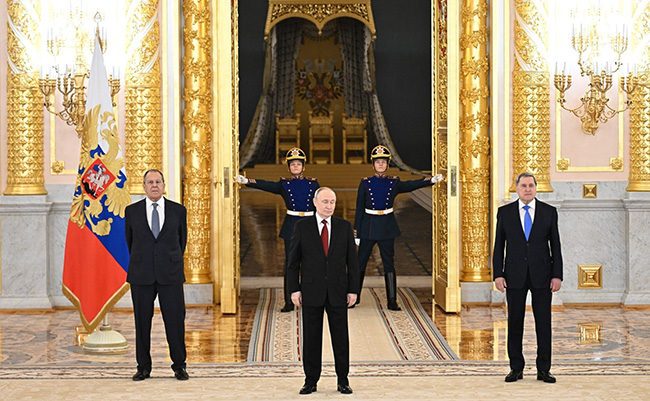 Before the ceremony to present diplomatic credentials
Photo: Kremlin.ru
Vladimir Putin received the letters of credence from newly appointed ambassadors of foreign nations. The ceremony took place in the St Alexander Hall of the Grand Kremlin Palace, Kremlin informs.
The Kremlin, Moscow, January 15, 2026
The letters of credence were presented to the President of Russia by: Alenka Suhadolnik (Republic of Slovenia), Mohamed Abukar Zubeyr (Federal Republic of Somalia), Sosthene Ndembi (Gabonese Republic), Shobini Kaushala Gunasekera (Democratic Socialist Republic of Sri Lanka), Nicolas Louis Marie Olivier de Rivière (French Republic), Stephan Sylvain Sambou (Republic of Senegal), Joseph Nzabamwita (Republic of Rwanda), Daniel Kostoval (Czech Republic), Sidati Cheikh Ould Ahmed Aisha (Islamic Republic of Mauritania), Mawlawi Gul Hassan Hassan (Islamic Emirate of Afghanistan), Toufik Djouama (People's Democratic Republic of Algeria), Sara Feronha Martins (Portuguese Republic), Nazrul Islam (People's Republic of Bangladesh), Sérgio Rodrigues dos Santos (Federative Republic of Brazil), Heidi Olufsen (Kingdom of Norway), Anna Christina Thérése Johannesson (Kingdom of Sweden), Hamdy Shaaban Abdelhalim Mohammed (Arab Republic of Egypt), Jorge Ignacio Zorro Sánchez (Republic of Colombia), Sami Mohammed Al-Sadhan (Kingdom of Saudi Arabia), Koma Steem Jehu-Appiah (Republic of Ghana), Monica Ndiliawike Nashandi (Republic of Namibia), Gerhard Sailler (Republic of Austria), Enrique Orta González (Republic of Cuba), Faisal Niaz Tirmizi (Islamic Republic of Pakistan), Lee Sok-bae (Republic of Korea), Manuel Augusto De Cossío Klüver (Republic of Peru), María del Rosario Portell Casanova (Oriental Republic of Uruguay), Bashir Saleh Azzam (Republic of Lebanon), Jürg Stephan Burri (Swiss Confederation), Abdul-Karim Hashim Mostafa (Republic of Iraq), Stefano Beltrame (Italian Republic), and Abdul Raheem Abdul Latheef (Republic of Maldives).
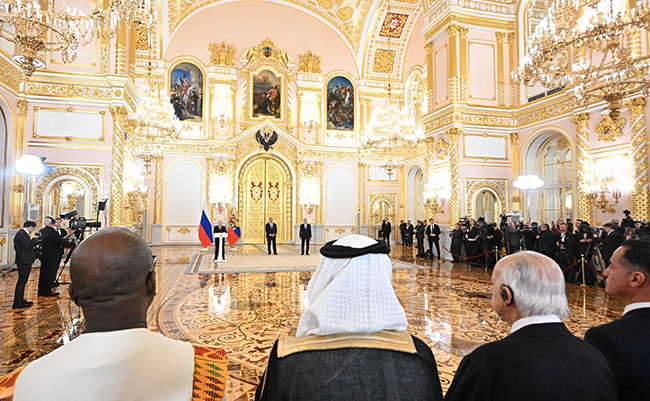 Photo: Kremlin.ru
Speech at the ceremony for presenting letters of credence
President of Russia Vladimir Putin: Ladies and gentlemen,
First, I would like to warmly welcome you to the Kremlin for this formal ceremony to present your letters of credence. Our meeting comes at the very start of a new year – a time when we all look to the future with our plans and, naturally, with the hope that difficulties, hardships, mutual recriminations, and conflicts will be left behind. Therefore, I would like to take this opportunity to offer my heartfelt wishes for prosperity and success in 2026 to you, your families, and the peoples of the nations you represent.
You will, I trust, agree that international cooperation is fundamental to humanity’s sustainable development and prosperity. In today’s diverse and interconnected world, global stability and security depend directly on the ability of states to interact constructively. Open and honest partnerships create the conditions needed to tackle our shared challenges, even the most complex ones.
There is a reason why people say that peace does not come by itself. It must be built, day-by-day, and it is a painstaking process. Achieving peace requires effort, a sense of responsibility and the ability to make deliberate choices. This posture is especially relevant today considering the increasingly deteriorating international environment. I think that no one would claim otherwise. Old conflicts are escalating, while new serious hotbeds of tension emerge.
At the same time, unilateral and dangerous actions often substitute diplomacy, efforts to come to a compromise or find solutions which would suit everyone. Instead of having states engage in dialogue with one another, there are those relying on the might-makes-right principle to assert their unilateral narratives, those who believe that they can impose their will, lecture others how they must live and issue orders.
Dozens of countries across the world have been suffering from the infringement of their sovereign rights, from chaos and lawlessness. They lack the strength and resources to stand up for themselves.
Placing a greater emphasis on having all members of the international community respect international law, as well as facilitating the advent of new emerging trends and a fair multipolar world order can be viewed as a reasonable solution. In this world order, all states would have the right to follow their own development models and to define their future independently, without outside interference, while preserving their unique culture and traditions.
I would like to note that Russia is sincerely committed to the ideals of a multipolar world. Our country has always pursued and will continue to pursue a balanced, constructive foreign policy course that takes into account both our national interests and the objective trends of global development.
We are determined to maintain truly open and mutually advantageous relations with all partners interested in cooperation, deepening ties in politics, the economy and culture, and jointly confronting acute challenges and common threats.
Russia advocates for strengthening the key, central role of the United Nations in global affairs, the organisation that celebrated its anniversary last year.
Eight decades ago, our fathers, grandfathers, and great-grandfathers, having emerged victorious in the Second World War, were able to unite, find a balance of interests, and agree on the fundamental rules and principles of international communication, enshrining them in their entirety, completeness, and interconnectedness in the UN Charter.
The imperatives of this foundational document, such as equality, respect for sovereignty, non-interference in internal affairs, and the resolution of disputes through dialogue, are now more relevant than ever. Most importantly, we must proceed from the understanding that security must be truly comprehensive and, therefore, equal and indivisible, and it cannot be ensured for some at the expense of the security of others. This principle is enshrined in fundamental international legal instruments.
Disregarding this basic, vital principle has never led to anything good and never will. This has been clearly demonstrated by the crisis around Ukraine, which became a direct consequence of years of ignoring Russia’s legitimate interests and a deliberate policy of creating threats to our security, including the advancement of the NATO bloc towards Russia’s borders – contrary to the public promises made to us. I want to emphasise this: contrary to the public promises made to us.
Let me remind you that Russia has repeatedly put forward initiatives to build a new, reliable, and fair architecture of European and global security. We have proposed options and rational solutions that could satisfy everyone in America, Europe, Asia, and across the world.
We believe it would be worthwhile to return to a substantive discussion of these proposals to establish the conditions under which a peaceful settlement of the conflict in Ukraine could be achieved – and the sooner, the better.
It is precisely a long-term and sustainable peace, one that reliably ensures the security of all and everyone, that our country strives for. Not everywhere, including in Kiev and the capitals that support it, are they ready for this. But we hope that an awareness of this necessity will come sooner or later. Until then, Russia will continue to consistently pursue its objectives.
At the same time, I would like to reiterate and ask you to bear in mind in your activities that Russia is always open to building equal and constructive relations with all international partners for the sake of universal prosperity, well-being, and development.
Ladies and gentlemen,
Taking part in today’s ceremony are ambassadors from 32 countries. Every one of them is an active member of the United Nations and makes their own contribution to addressing essential tasks on the global agenda.
Many of you represent countries that are Russia’s strategic partners and allies with whom we share relations of friendship, cooperation, and mutual support; countries with which we work actively within large international and regional associations.
I am confident that the Brazilian ambassador will agree that our two states, who were the founding members of BRICS, share the same views regarding the necessity to build a truly just multipolar world order.
Russia-Brazil cooperation is developing progressively, gaining new mutually beneficial projects across various fields. As you know, just yesterday I had a telephone conversation with President Lula da Silva. This conversation reaffirmed our shared approaches to global and regional processes, as well as the fact that our positions on many key issues either coincide or are very close.
I would like to emphasise that Russia and the Republic of Cuba enjoy genuinely strong and friendly relations. We have consistently provided assistance and support to our Cuban friends. Russia stands in solidarity with Cuba’s firm determination to defend its sovereignty and independence.
The Russian-Cuban alliance has withstood the test of time and is rooted in the sincere mutual goodwill of our peoples. Together, we are implementing projects of critical importance to the Cuban economy in areas such as energy, metallurgy, transport infrastructure, and healthcare, while also expanding cultural and humanitarian exchanges.
I would also like to underscore that Russia has long maintained close, constructive relations with many countries of Latin America, treating the states of the region with the utmost respect as equal, sovereign partners.
This fully applies to the countries represented here today: Colombia, Peru, and Uruguay. We can see significant potential for expanding trade, investment, and business cooperation, as well as collaboration in healthcare, pharmaceuticals, education, and professional training.
In the same spirit of partnership and mutual trust, Russia remains committed to further strengthening its engagement with the countries of the Middle East and North Africa.
A special role in this region is played by Egypt, a friendly country to Russia. Our relations are based on the Comprehensive Partnership and Strategic Cooperation Agreement. Our two countries are successfully implementing major joint initiatives, such as the construction of the El Dabaa Nuclear Power Plant and the establishment of a Russian industrial zone in the Suez Canal area.
In a month, we will mark the centenary of establishing diplomatic relations between Russia and the Kingdom of Saudi Arabia. Our bilateral partnership has evolved into a comprehensive and steadily expanding relationship. Close coordination within the OPEC Plus format has been established and continues to play a genuinely important role in maintaining stability in the global oil market.
We welcome the Kingdom’s decision to serve as a guest country at the St Petersburg International Economic Forum to be held in June. Of particular note is Saudi Arabia’s intention to host the Intervision International Music Competition, which has been revived at Russia’s initiative.
Relations with Lebanon and Iraq have traditionally developed in the spirit of mutual respect and goodwill. Russia has consistently supported the unity, sovereignty, and independence of these states and firmly opposes any external interference in their domestic affairs.
We maintain close cooperation with Pakistan, a full member of the Shanghai Cooperation Organisation, the largest regional organisation in terms of economic, technological, and human potential. Russian-Pakistani relations are genuinely mutually beneficial.
Afghanistan holds observer status in the SCO. In recent years, Russian-Afghan cooperation has gained notable momentum, facilitated by Russia’s decision last year to officially recognise the country’s new authorities. We are sincerely interested in seeing Afghanistan emerge as a united, independent, and peaceful state, free from war, terrorism, and drug trafficking.
Our cooperation with Sri Lanka, Bangladesh, and the Republic of Maldives is progressing very effectively. We are successfully expanding engagement in traditional areas such as tourism, fisheries, agriculture, and energy, while remaining committed to developing cooperation in other spheres of mutual interest.
Today’s ceremony is attended by a broad representation of ambassadors from friendly African nations: Somalia, Gabon, Senegal, Rwanda, Mauritania, Algeria, Ghana, and Namibia. Russia maintains relations with all states on the continent based on genuine partnership, mutual support, and solidarity.
The foundations of these relations were forged during the period when African nations were fighting for freedom and independence. Our country made a significant contribution to liberating African states from colonial oppression, to establishing their statehood, to developing their national economies and social sectors, as well as to the training and equipping of their armed forces.
We remain steadfast in our commitment to expanding mutual political, economic, and cultural ties. We continue to provide assistance and support to African nations in their pursuit of development and active participation in international affairs.
All these matters were discussed in detail at the Russia–Africa summits in Sochi and St Petersburg, as well as at the ministerial conference of the Russia–Africa Partnership Forum held a month ago in Cairo. Preparations are underway for the third Russia–Africa Summit, which is scheduled to take place this year.
Unfortunately, much of the positive momentum in our relations with the Republic of Korea has been eroded. Yet in the past, by adhering to pragmatic approaches, our countries achieved truly positive results in trade and business. We look forward to restoring relations with the Republic.
With each of the European states represented here – Slovenia, France, the Czech Republic, Portugal, Norway, Sweden, Austria, Switzerland, and Italy – our relations have deep historical roots and are rich in examples of constructive partnership and mutually enriching cultural cooperation.
The current state of bilateral ties between the aforementioned countries and Russia leaves much to be desired. Dialogue and contacts – through no fault of ours, I must emphasise – have been reduced to a minimum, both at the official level and in business and civil society circles. Cooperation on key international and regional issues has been frozen.
It is my hope that, in time, the situation will nevertheless change, and our nations will return to normal, constructive dialogue based on respect for national interests and due consideration of legitimate security concerns. Russia has been and remains committed to such approaches and is prepared to restore the required level of relations.
More broadly, as I have stated on multiple occasions, we are open to constructive and mutually beneficial cooperation with all countries without exception. Naturally, we are keen to ensure that the work of each ambassador present here yields the most fruitful results.
Ladies and gentlemen, you may rest assured that all constructive initiatives you propose will receive support from the Russian leadership, executive authorities, the business community, and civil society.
Allow me to wish you success and all the best in your endeavours.
Thank you for your attention.


Nicolas de RIVIÈRE, né le 26 septembre 1963.
RépondreSupprimerLicence en droit
Diplôme de l’Institut d’études politiques
Ancien élève de l’École nationale d’administration, promotion "Condorcet", 1992
Ambassadeur de France auprès de la Fédération de Russie depuis mars 2025